
LATEST NEWS
News & Insights
What's New in Windows & Doors
- Company News
- Buying Guides
- Industry Insights
- Product Innovations
Understanding Window Performance Ratings: Air Tightness, Water Resistance, Wind Load and Sound Insulation
Overview
Window performance should be evaluated through four important indicators: air tightness, water resistance, wind-load resistance, and sound insulation. Water resistance, also called watertightness or resistance to water penetration, describes how a window manages water exposure under specified testing conditions. A test report for a smaller window does not automatically establish the performance of a substantially larger window.
Key Takeaways
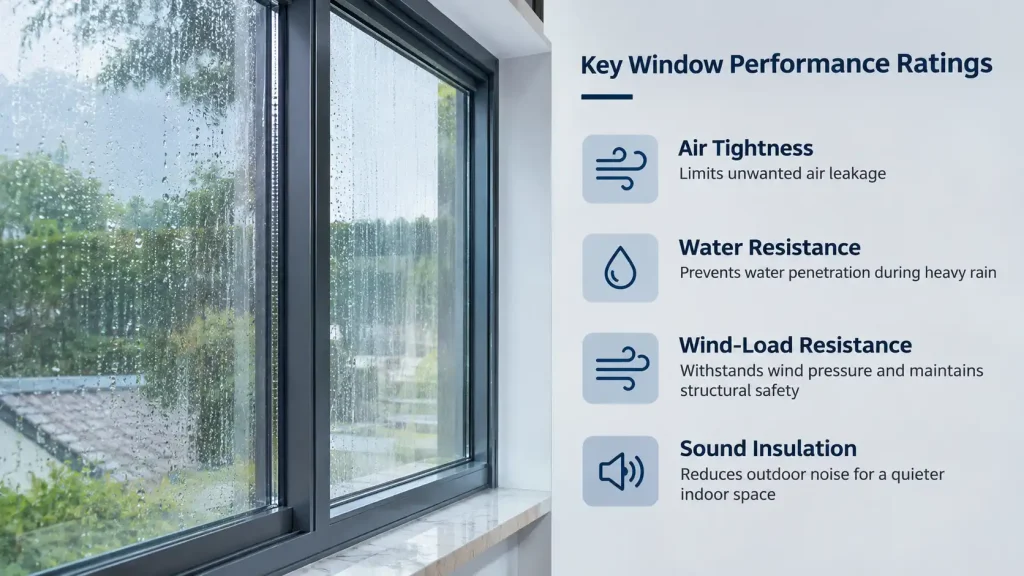
- Window performance should be evaluated through four important indicators: air tightness, water resistance, wind-load resistance, and sound insulation.
- Air tightness measures unwanted air leakage, while water resistance evaluates a window's ability to prevent unacceptable water penetration under specified test conditions.
- Wind-load performance describes how a window responds to positive and negative pressure, including deformation, structural resistance, and safety.
- Sound insulation is commonly expressed using acoustic ratings such as Rw or STC. A higher rating generally indicates better laboratory sound insulation, but actual indoor noise reduction depends on installation and environmental conditions.
- In Malaysia, MS 832:2022 provides an important technical reference for aluminium alloy windows, including performance testing requirements.
- Buyers should verify complete test reports, specimen dimensions, test methods, and performance classifications rather than relying on isolated numbers or unsupported marketing claims.
1. Introduction
When purchasing aluminium windows in Malaysia, buyers frequently encounter technical descriptions such as "high water resistance," "excellent air tightness," "strong wind-pressure resistance," and "40 dB sound insulation."
These claims can sound reassuring.
However, without understanding how window performance is measured, homeowners and contractors may struggle to determine whether the specifications are meaningful.
A window described as highly waterproof may still experience leakage when installed incorrectly.
Similarly, a product advertised with strong acoustic performance may not deliver the same noise reduction after installation if gaps remain between the frame and surrounding wall.
Malaysia's tropical climate makes these considerations particularly important.
According to the Malaysian Meteorological Department (MetMalaysia), the country's climate is characterised by relatively uniform temperatures, high humidity, and substantial rainfall.
During seasonal monsoon periods, certain regions experience prolonged heavy rain and strong winds.
Urban properties in Kuala Lumpur, Penang, and Johor Bahru may also face traffic noise, while high-rise buildings introduce additional wind-pressure and installation challenges.
Therefore, evaluating window performance requires more than examining aluminium thickness or glazing specifications.
Buyers need to understand the performance of the complete window assembly.
This guide explains four essential window performance indicators, how they are tested, what the measurements mean, and how Malaysian buyers can verify technical claims before purchasing.
2. Air Tightness: Understanding Air Leakage Performance
What Is Window Air Tightness?
Air tightness describes a window's ability to limit unwanted air movement through its assembled components when a pressure difference exists between the indoor and outdoor environments.
Even when a window is closed, air may pass through small gaps around the sash, frame joints, locking points, and weather seals.
The amount of leakage depends on several factors, including:
- Window opening type.
- Frame and sash geometry.
- Gasket material and compression.
- Hardware adjustment.
- Locking-point configuration.
- Manufacturing accuracy.
- Installation quality.
A window with reliable air tightness helps reduce uncontrolled air movement.
This can be particularly useful in air-conditioned buildings, where unwanted infiltration may increase cooling and dehumidification requirements.
However, air tightness should not be confused with ventilation.
Ventilation provides intentional air exchange, while air leakage represents uncontrolled airflow through the building envelope.
How Is Air Tightness Tested?
Laboratory air leakage testing generally applies a controlled pressure difference across a closed window specimen.
The testing equipment measures the amount of air passing through the assembly.
Depending on the applicable standard, results may be expressed as:
- Cubic metres per hour (m³/h).
- Cubic metres per hour per square metre (m³/h·m²).
- Litres per second per square metre (L/s·m²).
- Leakage per unit length of opening joint.
The pressure difference itself is normally measured in pascals (Pa).
These units describe different quantities.
Pascal (Pa) measures pressure, while airflow units measure leakage.
For example, stating that a window has an air tightness of "100 Pa" is incomplete.
The pressure value identifies a test condition, not the amount of air leaking through the window.
A meaningful report should specify the applied pressure and the measured leakage rate.
Example: Comparing Two Hypothetical Windows
Suppose two windows are tested under identical conditions.
| Test Indicator | Window A | Window B |
|---|---|---|
| Test pressure | 100 Pa | 100 Pa |
| Air leakage rate | 1.5 m³/h·m² | 3.5 m³/h·m² |
| Relative leakage | Lower | Higher |
Under these assumed test conditions, Window A demonstrates lower air leakage.
However, these figures are illustrative only.
They are not official Malaysian classification thresholds or certified product results.
Different standards may specify different test pressures, procedures, and acceptance criteria.
Why Air Tightness Matters in Malaysia
Air tightness is especially relevant for:
Air-conditioned condominiums
Reducing uncontrolled air infiltration can help maintain more stable indoor conditions.
Properties near busy roads
Better sealing can reduce some pathways through which outdoor noise and dust enter.
High-rise residential buildings
Pressure differences caused by wind and building operation can influence air movement through windows.
Commercial offices
Controlled air leakage can support building envelope performance and mechanical ventilation strategies.
However, an airtight window does not replace proper ventilation.
Buildings still require appropriate fresh-air provision and humidity management.
What Should Buyers Verify?
Request the applicable air leakage test report and confirm:
- The testing standard.
- The specimen dimensions.
- The test pressure.
- The leakage measurement units.
- The resulting performance classification.
- Whether the tested configuration matches the proposed product.
A supplier's general statement about "excellent sealing" is not a substitute for documented performance.
3. Water Resistance: How Windows Perform During Heavy Rain
What Is Window Water Resistance?
Water resistance, also called watertightness or resistance to water penetration, describes how a window manages water exposure under specified testing conditions.
For Malaysian buildings, this is one of the most important window performance characteristics.
Heavy rainfall can expose weaknesses in frame joints, gaskets, drainage systems, and installation interfaces.
However, water resistance does not mean that every part of the window must remain completely dry internally.
Many window systems incorporate drainage channels designed to collect and discharge water before it reaches the interior.
The important distinction is whether water penetration exceeds the acceptance criteria defined by the applicable test standard.
How Is Water Resistance Tested?
Laboratory water penetration testing typically involves spraying water onto the exterior side of a window while applying a controlled pressure difference.
For example, ASTM E331 describes a method for evaluating water penetration through exterior windows and related assemblies under a uniform static air-pressure difference.
The test considers water exposure and the behaviour of the manufactured assembly under defined conditions.
Relevant measurements may include:
- Test pressure in pascals (Pa).
- Water application rate.
- Test duration.
- Location of observed water penetration.
- Pass or fail result under the applicable acceptance criteria.
A window that passes at one pressure level does not automatically satisfy every higher pressure requirement.
The tested pressure and acceptance criteria must be considered together.
Understanding Water Resistance Ratings
Consider the following hypothetical results.
| Window System | Test Pressure | Reported Result |
|---|---|---|
| System A | 150 Pa | Pass |
| System B | 300 Pa | Pass |
| System C | 450 Pa | Pass |
If the systems were tested using comparable methods and acceptance criteria, System C demonstrates successful performance at a higher test pressure.
However, these results do not establish that System C is suitable for every building.
A project's required performance depends on its location, design exposure, window dimensions, and applicable specifications.
Furthermore, different testing methods may produce results that should not be compared directly.
Common Causes of Window Leakage
Several factors can contribute to water ingress.
1. Inadequate drainage
Poorly designed or blocked drainage openings may prevent collected water from leaving the frame.
2. Damaged or poorly compressed gaskets
Weather seals may become ineffective due to damage, incorrect installation, or inadequate sash compression.
3. Frame joint defects
Manufacturing inconsistencies can create pathways for water penetration.
4. Incorrect installation
Gaps between the window frame and building structure may allow water to enter.
5. Unsuitable window selection
A system designed for sheltered residential applications may not provide the performance required for a highly exposed façade.
6. Surrounding wall defects
Cracks, waterproofing failures, or poorly sealed wall interfaces can cause leakage that appears to originate from the window.
A professional inspection should identify the actual water entry path before recommending replacement.
How Window Manufacturers Improve Water Resistance
Common engineering approaches include:
- Multi-stage weather sealing.
- Compression gaskets.
- Pressure-managed cavities.
- Dedicated drainage channels.
- Protected frame joints.
- Controlled water discharge paths.
SYSTIN's technical product information describes several systems incorporating multi-layer sealing arrangements and specialised drainage structures.
For example, selected Titan thermal-break casement windows feature three sealing layers and a dedicated drainage design.
These features are relevant to water management.
However, their presence alone does not establish a certified pressure rating.
Important clarification: Some manufacturer product descriptions use water-resistance figures such as 5.66 Pa or 7.23 Pa. These values should not be presented as verified watertightness test pressures without reviewing the original laboratory reports, measurement definitions, and units.
For Malaysian procurement, buyers should request the original test documentation rather than comparing isolated numbers from marketing materials.
4. Wind-Load Resistance: Structural Safety and Performance
What Is Wind-Load Resistance?
Wind-load resistance describes how a window assembly responds to wind-induced pressure acting on its surfaces.
Wind can generate both positive and negative pressures.
Positive pressure generally pushes against the window, while negative pressure can act as suction.
A window must be designed to withstand the relevant loads without unacceptable deformation, damage, or structural failure.
Important structural components include:
- Aluminium profiles.
- Mullions and transoms.
- Frame corner connections.
- Glass panels.
- Hinges and locking hardware.
- Structural fasteners.
- Anchoring connections.
Wind resistance depends on the entire system, not simply the thickness of the aluminium profile.
How Is Wind Resistance Tested?
Structural performance testing generally applies controlled positive and negative pressure to a window specimen.
The procedure may examine:
Deflection
How far a frame or other structural member moves under load.
Permanent deformation
Whether components remain distorted after the load is removed.
Structural integrity
Whether the assembly maintains its required integrity under specified conditions.
Proof-load behaviour
Whether the window withstands designated loading without unacceptable failure.
The relevant standard determines the test procedure, loading sequence, and acceptance criteria.
Understanding Wind Pressure
Wind pressure is commonly expressed in pascals (Pa) or kilopascals (kPa).
One kilopascal equals 1,000 pascals.
The total force acting on a surface depends on the pressure and exposed area.
A simplified relationship is:
Force (N) = Pressure (Pa) × Area (m²)
For example, consider a hypothetical window measuring 2 metres wide and 1.5 metres high.
Its area is:
2 × 1.5 = 3 m²
If a uniform net pressure of 1,000 Pa acts across the window, the resulting simplified total force is:
1,000 × 3 = 3,000 N
This example illustrates why large windows require careful structural evaluation.
It is not a project wind-load calculation.
Actual design must consider applicable wind-loading requirements, pressure coefficients, building geometry, local exposure, and appropriate safety factors.
Why Wind Resistance Matters for Malaysian Buildings
Wind-load requirements vary significantly according to building conditions.
Important considerations include:
High-rise condominiums
Wind exposure can increase with elevation and building geometry.
Coastal buildings
Open coastal terrain may result in different exposure conditions from sheltered urban locations.
Large panoramic windows
Large glass areas and long unsupported frame members may require additional structural design.
Commercial façades
Extensive glazing systems often require project-specific engineering assessment.
A small ground-floor window in a sheltered location should not automatically be specified in the same way as a large window installed high on an exposed building.
Does Thicker Aluminium Always Mean Better Wind Resistance?
No.
Profile thickness is only one component of structural design.
A 3.0 mm aluminium frame may offer advantages over a thinner profile in certain configurations, but it does not automatically provide superior tested performance.
Profile geometry, alloy temper, reinforcement, joints, glass support, and anchoring details also influence structural behaviour.
SYSTIN's product range includes window systems with different profile thicknesses, including selected 2.0 mm and 3.0 mm configurations.
These differences should be evaluated alongside the complete window design and relevant structural test results.
Buyers should avoid choosing windows solely on the basis of wall thickness.
5. Sound Insulation: Understanding dB, Rw and STC
What Is Window Sound Insulation?
Sound insulation describes the ability of a window assembly to reduce airborne sound transmission.
This is particularly relevant to Malaysian properties located near:
- Major roads and highways.
- Railway infrastructure.
- Commercial districts.
- Construction activity.
- Busy urban environments.
Noise reduction depends on more than glass thickness.
The entire window assembly influences sound transmission.
Important factors include glass composition, frame design, weather seals, opening mechanisms, and installation quality.
Understanding Decibels (dB)
Decibels are used to express sound-related quantities on a logarithmic scale.
However, a sound insulation figure expressed in dB must be interpreted in context.
A manufacturer might advertise a window with "40 dB sound insulation."
Without additional information, this statement is ambiguous.
It may refer to a laboratory sound reduction rating, a measured sound level difference, or another acoustic quantity.
These measurements are not interchangeable.
What Is Rw?
Rw stands for Weighted Sound Reduction Index.
It is a single-number rating commonly used to describe the airborne sound insulation performance of building elements based on laboratory measurements.
ISO 717-1 provides methods for determining single-number airborne sound insulation ratings.
A higher Rw value generally indicates better overall laboratory sound insulation.
However, the Rw rating alone does not fully describe how a window performs against every type of noise.
Different sound sources contain different frequency characteristics.
Traffic noise, machinery, and human speech may therefore require additional consideration.
What Is STC?
STC stands for Sound Transmission Class.
It is another single-number acoustic rating used to describe airborne sound insulation, particularly in North American testing and specification systems.
Rw and STC are related concepts, but they are calculated using different rating procedures.
They should not automatically be treated as identical.
Buyers should identify which acoustic rating system a supplier uses.
Example: Comparing Acoustic Window Ratings
| Hypothetical Window | Laboratory Rating | General Interpretation |
|---|---|---|
| Window A | Rw 30 dB | Lower rated sound insulation |
| Window B | Rw 35 dB | Higher rated sound insulation |
| Window C | Rw 40 dB | Higher rated sound insulation than A or B |
This table is illustrative and assumes comparable laboratory testing and rating methods.
It does not mean that Window C will reduce every outdoor sound level by exactly 40 dB inside an occupied room.
Actual indoor sound levels depend on surrounding walls, ventilation openings, installation gaps, room acoustics, and the frequency characteristics of the sound source.
Why Installation Quality Matters
Even a well-tested acoustic window can perform poorly if sound travels through gaps around the frame.
Typical problem areas include:
- Incomplete perimeter sealing.
- Poorly compressed gaskets.
- Misaligned opening sashes.
- Unsealed ventilation paths.
- Weak surrounding wall construction.
For Malaysian homeowners experiencing traffic noise, the best approach is to identify the dominant sound transmission pathways before selecting replacement windows.
A laboratory rating should be treated as evidence of product capability, not a guarantee of identical on-site performance.
6. Comparing the Four Window Performance Indicators
The following table summarises how each performance category should be interpreted.
| Performance Indicator | Primary Measurement | Main Purpose | Important Buyer Question |
|---|---|---|---|
| Air tightness | Air leakage rate under specified pressure | Limits uncontrolled air infiltration | What is the measured leakage rate? |
| Water resistance | Test pressure and penetration result | Evaluates resistance to water ingress | At what pressure did the window pass? |
| Wind-load resistance | Pressure, deflection, and structural results | Assesses structural performance | Is the system suitable for the required design loads? |
| Sound insulation | Rw, STC, or other specified acoustic ratings | Evaluates airborne sound reduction | Which test method and rating were used? |
These indicators describe different performance characteristics.
A window performing well in one category may not necessarily achieve the same level in another.
For example:
- A window with excellent air tightness may still require better drainage design.
- A structurally strong window may have limited acoustic insulation.
- A high-acoustic-performance glazing unit may not provide optimal solar control.
- A thermal-break frame may not automatically improve resistance to wind-driven rain.
The correct purchasing decision requires an assessment of the complete performance profile.
Malaysian Standard MS 832:2022
An important reference for aluminium windows in Malaysia is:
MS 832:2022 — Aluminium Alloy Windows — Specification (Second Revision)
Published by the Department of Standards Malaysia, this standard addresses materials, construction, finishes, hardware, and performance requirements for aluminium alloy windows.
Its structure includes provisions concerning:
- Air leakage testing.
- Watertightness testing.
- Structural performance testing.
- Proof-load testing.
- Operation and strength testing.
- Inspection and reporting.
MS 832:2022 replaced the earlier MS 832:2011 edition.
Malaysia's Construction Industry Development Board (CIDB) has also issued information concerning the implementation of MS 832:2022 and MS 1017:2022 under the Fourth Schedule of Act 520.
For projects involving regulated aluminium windows or sliding glass doors, buyers should confirm the applicable product conformity requirements and supporting certification documentation.
The applicable Malaysian standard, project specifications, and current regulatory requirements should take priority over generic international marketing claims.
How to Read a Window Test Report
Before accepting a supplier's stated performance rating, examine the following information.
| Verification Item | What to Check |
|---|---|
| Testing laboratory | Laboratory identity and relevant competence or accreditation |
| Product identification | Exact model and configuration |
| Specimen dimensions | Width, height, and tested arrangement |
| Testing standard | Standard number and edition |
| Test conditions | Pressure, duration, temperature, or other relevant parameters |
| Performance results | Actual measurements and observations |
| Classification | Applicable rating or pass/fail result |
| Report date | Whether the report remains relevant to the product design |
| Tested components | Glass, hardware, frame, and sealing configuration |
| Limitations | Conditions under which the results apply |
A test report for a smaller window does not automatically establish the performance of a substantially larger window.
Likewise, changing hardware, glazing, or frame details may affect performance.
Any extension of tested results to other product configurations should follow the rules of the applicable standard or an appropriate engineering assessment.
7. Practical Window Selection for Malaysian Buildings
Different buildings require different performance priorities.
| Building Scenario | Primary Performance Concerns | Recommended Evaluation |
|---|---|---|
| Kuala Lumpur condominium | Air leakage, noise, wind load | Tested air, acoustic, and structural performance |
| Penang coastal residence | Corrosion, water penetration, wind load | Weather resistance and material durability |
| Johor Bahru landed house | Rain protection, ventilation, maintenance | Water resistance, hardware, and installation |
| High-rise apartment | Wind load, safety, leakage | Structural and weather-performance documentation |
| Commercial office | Air tightness, thermal comfort, sound insulation | Integrated façade and window performance |
| Roadside residential property | Traffic noise, air leakage | Acoustic testing and sealing quality |
These are general planning priorities.
The final performance requirements should be determined by the project designer, applicable standards, and local site conditions.
Evaluating Manufacturer Specifications
SYSTIN, a Chinese system window and door manufacturer founded in 2010, offers window systems incorporating different glazing configurations, aluminium profiles, weather-sealing arrangements, and hardware.
Selected product descriptions include acoustic performance figures and water-resistance claims.
These specifications may help buyers identify relevant products for further evaluation.
However, marketing figures should not be presented as independently verified performance ratings unless their associated test documentation is available.
In particular, water-resistance values require careful verification of units, test methods, and classification systems.
For Malaysian procurement, buyers should request current model-specific reports and confirm whether the proposed windows meet applicable local requirements.
Transparent technical documentation is more valuable than unsupported claims of superior performance.
8. Frequently Asked Questions
9. Conclusion
Understanding window performance ratings helps Malaysian homeowners, contractors, and developers make better-informed purchasing decisions.
Air tightness, water resistance, wind-load resistance, and sound insulation each describe a different aspect of window performance.
They should not be confused or evaluated through isolated marketing figures.
Air leakage rates explain how effectively a closed window limits uncontrolled airflow.
Water-resistance testing evaluates performance under specified water exposure and pressure conditions.
Wind-load testing assesses structural behaviour, while acoustic ratings describe laboratory sound insulation characteristics.
For Malaysian buildings, these indicators are especially relevant because of the country's heavy rainfall, tropical climate, urban noise, and varied building exposure conditions.
A reliable window should not simply claim to be waterproof, soundproof, or wind-resistant. Its relevant performance should be supported by identifiable test methods, documented results, and suitability for the intended application.
Manufacturers such as SYSTIN provide window systems with different structural and sealing configurations, but buyers should verify model-specific test documentation before relying on particular performance claims.
For projects in Malaysia, MS 832:2022 and relevant CIDB requirements provide important references for assessing product conformity.
Ultimately, the most trustworthy window supplier is one that explains what its performance figures mean, provides supporting evidence, and clearly identifies the conditions under which those results apply.
Before placing an order, request the complete technical specifications, applicable test reports, and installation requirements.
A properly documented window system offers a stronger foundation for safety, comfort, and long-term reliability than marketing claims alone.
Technical References
-
Department of Standards Malaysia — MS 832:2022, Aluminium Alloy Windows — Specification (Second Revision).
Malaysian standard covering window materials, construction, finishes, hardware, performance testing, and reporting.
https://mysol.jsm.gov.my/ -
Construction Industry Development Board Malaysia (CIDB) — Product Conformity and MS 832:2022 Implementation.
Official information concerning regulated construction products and applicable Malaysian standards.
https://ccpm.cidb.gov.my/ -
ASTM International — ASTM E331, Standard Test Method for Water Penetration of Exterior Windows, Skylights, Doors, and Curtain Walls by Uniform Static Air Pressure Difference.
https://www.astm.org/e0331-00r23.html -
International Organization for Standardization — ISO 717-1:2020, Acoustics — Rating of Sound Insulation in Buildings and of Building Elements — Part 1: Airborne Sound Insulation.
https://www.iso.org/standard/77435.html -
Malaysian Meteorological Department (MetMalaysia) — Malaysia's Climate.
Official information covering tropical climate characteristics, rainfall, and monsoon conditions.
https://www.met.gov.my/en/pendidikan/iklim-malaysia/ -
SYSTIN — Brand and Product Technical Knowledge Base.
Manufacturer-provided information covering aluminium window profiles, glazing, weather sealing, drainage systems, and acoustic performance descriptions. Model-specific claims and testing units require verification against original reports before publication as certified performance data.
FAQs
What is the most important window performance rating in Malaysia?
There is no single rating that matters most for every building. Water resistance is especially important for exposed locations experiencing heavy rainfall. Air tightness can be important for air-conditioned properties, while wind-load resistance is critical for structurally exposed installations. Sound insulation becomes a priority for noise-sensitive locations. The correct specification depends on the building and its exposure conditions.
Does a higher water-resistance pressure mean a better window?
When tested under comparable methods and acceptance criteria, passing at a higher pressure generally indicates greater resistance to water penetration under those test conditions. However, buyers should verify the complete test report. Pressure ratings from different test methods should not be compared without understanding their procedures and limitations.
Does a 40 dB sound insulation rating mean outdoor noise will decrease by 40 dB?
Not necessarily. A laboratory acoustic rating describes performance under specified conditions. The reduction experienced inside a completed building depends on installation, surrounding construction, sound frequency, and other transmission paths. Buyers should confirm the rating method and evaluate the complete building situation.
How can I verify whether an aluminium window meets Malaysian standards?
Ask the supplier for relevant product conformity documents, applicable test reports, and identification of the Malaysian standards used. For aluminium alloy windows, MS 832:2022 is an important reference. Where CIDB product conformity requirements apply, verify the relevant certification or approval status through appropriate official channels.