LATEST NEWS
News & Insights
What's New in Windows & Doors
- Company News
- Buying Guides
- Industry Insights
- Product Innovations
Single, Double, Laminated or Low-E Glass: How to Choose Window Glazing in Malaysia
Overview
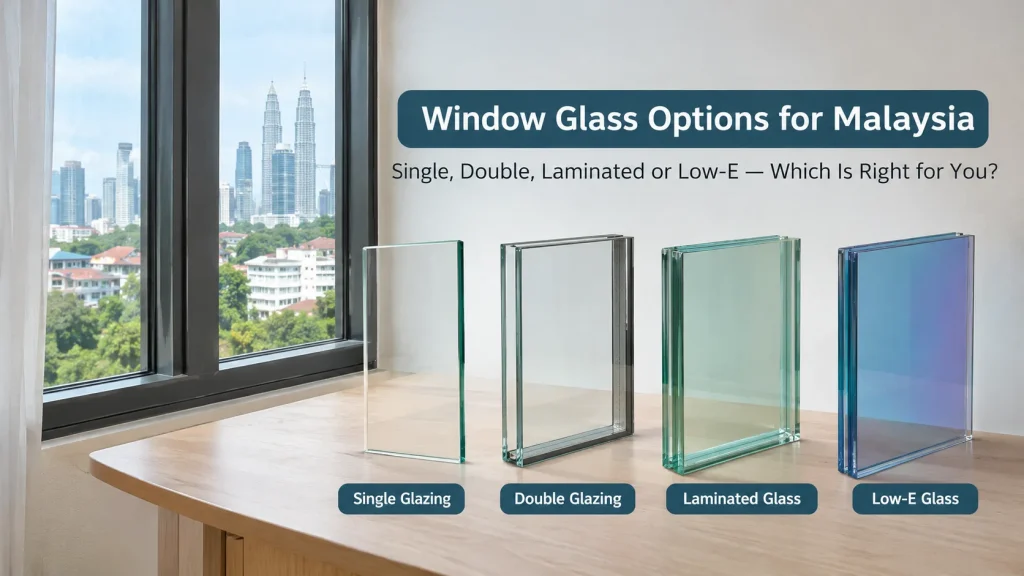
Choosing the right window glass in Malaysia requires balancing solar heat control, safety, sound insulation, natural daylight, and long-term performance. Buyers should request complete glass specifications, relevant test reports, and safety documentation rather than relying on marketing descriptions such as "premium glass" or "energy-saving glass." Double glazing, also called an Insulated Glass Unit (IGU), consists of two glass panes separated by a sealed cavity.
Key Takeaways
- Choosing the right window glass in Malaysia requires balancing solar heat control, safety, sound insulation, natural daylight, and long-term performance.
- Single glazing may be suitable for certain basic applications, while double glazing can improve thermal insulation when properly specified and installed.
- Laminated glass provides additional safety benefits by helping retain broken glass fragments and can improve acoustic performance when appropriate interlayers are used.
- Low-E glass can reduce heat transfer and, with the appropriate coating, limit solar heat gain. However, not all Low-E coatings provide the same level of solar protection.
- For Malaysian homes exposed to strong sunlight, Solar Heat Gain Coefficient (SHGC) is particularly important when comparing glazing options.
- Buyers should request complete glass specifications, relevant test reports, and safety documentation rather than relying on marketing descriptions such as "premium glass" or "energy-saving glass."
1. Introduction
Selecting window glass is one of the most important decisions when installing or replacing aluminium windows in Malaysia.
Although window frames, hardware, and architectural designs often receive considerable attention, the glazing itself has a major influence on indoor comfort, safety, energy performance, and noise transmission.
Malaysia's tropical climate introduces several challenges.
According to the Malaysian Meteorological Department (MetMalaysia), the country experiences relatively uniform temperatures, high humidity, and substantial rainfall throughout the year.
Solar radiation can increase indoor temperatures, particularly in rooms with large windows facing the afternoon sun.
Urban properties in Kuala Lumpur, Johor Bahru, and Penang may also experience traffic noise, while high-rise condominiums require careful consideration of glass safety and structural performance.
These conditions raise an important question:
Which window glass is most suitable for Malaysian homes: single glazing, double glazing, laminated glass, or Low-E glass?
There is no universal answer.
Each glazing technology addresses different performance requirements, and some technologies can be combined within the same insulated glass unit.
For example, a double-glazed window may incorporate laminated glass and a Low-E coating simultaneously.
Understanding these differences helps homeowners avoid unnecessary expenses while selecting glass that meets their actual needs.
This guide explains the major glazing options available in Malaysia, their advantages and limitations, and the technical specifications buyers should verify before purchasing.
2. Understanding the Four Main Window Glass Options
2.1 Single Glazing: Simple and Economical
Single glazing consists of one pane of glass installed within a window frame.
It remains a practical option for applications where advanced thermal insulation or acoustic control is not essential.
Single-glazed systems are generally simpler and may involve lower initial material costs than more complex glazing configurations.
However, a single pane provides relatively limited resistance to conductive heat transfer.
It may also offer less acoustic insulation than an appropriately designed laminated or insulated glazing system.
Advantages
- Relatively simple construction.
- Often lower initial material cost.
- Suitable for certain interior partitions and basic window applications.
- Compatible with various aluminium frame designs.
- Available in different thicknesses and safety-glass configurations.
Limitations
- Limited thermal insulation compared with properly designed insulated glazing.
- Acoustic performance depends strongly on thickness and installation.
- Clear glass may admit substantial solar radiation.
- Safety requirements still need to be assessed independently.
Suitable Malaysian Applications
Single glazing may be considered for sheltered areas, certain naturally ventilated spaces, and applications with limited thermal or acoustic requirements.
However, the decision should account for glass size, location, human impact risk, and applicable safety requirements.
A single pane is not necessarily unsafe, but the correct glass type and thickness must be selected for its intended use.
2.2 Double Glazing: Improved Thermal Insulation
Double glazing, also called an Insulated Glass Unit (IGU), consists of two glass panes separated by a sealed cavity.
The cavity may contain air or an insulating gas, depending on the product specification.
This construction reduces heat transfer compared with an otherwise comparable single-glazed assembly.
It can also improve certain acoustic characteristics, although the result depends on the complete glass configuration.
A typical specification might be:
5G + 20A + 5G
This commonly represents:
- First glass pane: 5 mm.
- Air cavity: 20 mm.
- Second glass pane: 5 mm.
The exact notation should always be confirmed with the manufacturer.
SYSTIN, a system window and door manufacturer founded in 2010, uses several insulated glazing configurations in its aluminium window product range.
For example, selected SYSTIN casement windows feature 5G+25A+5G insulated glazing, while other systems use different cavity dimensions.
These configurations demonstrate how insulated glass can be integrated into aluminium window systems.
However, a larger cavity does not automatically guarantee better performance.
Thermal and acoustic results also depend on spacer materials, cavity gas, glass coatings, edge seals, and the complete window assembly.
Advantages
- Reduced conductive heat transfer.
- Potential improvement in indoor thermal comfort.
- Compatibility with Low-E and laminated glass.
- Flexible configurations for residential and commercial applications.
- Potential acoustic benefits when designed appropriately.
Limitations
- Higher initial cost than basic single glazing.
- Greater weight and thickness.
- Requires compatible window profiles and glazing supports.
- Poor edge sealing can eventually cause moisture penetration into the cavity.
- Clear double glazing alone may still admit substantial solar heat.
Suitable Malaysian Applications
Double glazing is worth considering for air-conditioned bedrooms, condominiums, offices, and homes where thermal insulation is a priority.
However, Malaysian buyers should evaluate solar-control performance alongside the insulating properties.
2.3 Laminated Glass: Safety and Acoustic Protection
Laminated glass consists of two or more glass layers bonded together using an interlayer.
Common interlayer materials include polyvinyl butyral (PVB), although alternative interlayer technologies are also available.
When laminated glass breaks, the interlayer can help retain fragments and reduce the risk of loose shards falling away.
This makes laminated glass valuable in applications where glass retention is important.
Depending on the design, laminated glass can also contribute to improved sound insulation.
Specialised acoustic interlayers are available for projects requiring additional noise reduction.
Advantages
- Helps retain glass fragments after breakage.
- Can provide enhanced acoustic performance.
- Available in different thicknesses and configurations.
- Can be combined with insulated glass units.
- May provide ultraviolet protection depending on the interlayer.
Limitations
- Generally heavier than a comparable single pane.
- Often more expensive than basic monolithic glass.
- Acoustic performance varies by interlayer and glass construction.
- Structural and safety suitability must be verified for each application.
Suitable Malaysian Applications
Laminated glass may be appropriate for:
- Urban properties exposed to traffic noise.
- Certain balcony glazing applications.
- Glass installations where fragment retention is important.
- Residential spaces requiring additional safety considerations.
- Selected commercial and architectural glazing projects.
For high-rise or overhead applications, glass selection should be determined through applicable safety requirements and professional design.
It is important to understand that laminated glass does not automatically qualify every window for security, impact resistance, or fall protection.
Those functions require appropriate product specifications and supporting evidence.
2.4 Low-E Glass: Managing Heat and Solar Radiation
Low-E stands for low emissivity.
Low-E glass features a specialised coating that reduces the transfer of long-wave thermal radiation.
Different Low-E coating technologies can also influence how much solar energy enters a building.
This distinction is particularly important in Malaysia.
Low-E glass is not a single standard product with identical performance across all manufacturers.
Some coatings are designed to retain indoor heat in colder climates.
Others are designed to reduce unwanted solar heat gain in cooling-dominated buildings.
According to the National Fenestration Rating Council (NFRC), glazing performance should be evaluated using measurements such as U-factor, Solar Heat Gain Coefficient, and Visible Transmittance.
These values provide a more reliable basis for comparison than the Low-E designation alone.
Advantages
- Can reduce heat transfer.
- Solar-control variants can limit unwanted solar heat gain.
- Can maintain useful daylight transmission.
- Compatible with double glazing and laminated glass.
- May contribute to improved energy performance in air-conditioned buildings.
Limitations
- Performance varies significantly between coatings.
- Not all Low-E glass provides strong solar control.
- Higher initial cost than basic clear glazing.
- Requires appropriate coating placement and handling.
- Energy savings depend on the complete building and window system.
Suitable Malaysian Applications
Solar-control Low-E glazing may be particularly useful in:
- West-facing bedrooms.
- Air-conditioned living rooms.
- High-rise condominiums with extensive glazing.
- Commercial offices.
- Buildings with large exposed glass façades.
However, the final specification should consider window orientation, external shading, daylight requirements, and whole-building energy performance.
3. Comparing Glass Performance in Malaysia's Climate
The following table summarises the main differences between common glazing technologies.
| Glass Type | Thermal Insulation | Solar Heat Control | Acoustic Potential | Safety Characteristics | Typical Application |
|---|---|---|---|---|---|
| Clear single glazing | Limited | Limited | Basic | Depends on glass type | Basic or sheltered applications |
| Clear double glazing | Improved | May remain limited | Configuration-dependent | Depends on pane types | Air-conditioned residential spaces |
| Laminated glazing | Configuration-dependent | Depends on coatings | Can be improved | Fragment retention | Safety and noise-sensitive areas |
| Solar-control Low-E glazing | Can be improved | Often improved | Depends on glass build-up | Depends on glass type | Sun-exposed, air-conditioned rooms |
| Double glazing with laminated Low-E glass | Potentially high | Potentially high | Can be enhanced | Depends on complete assembly | Higher-performance projects |
Important: These comparisons describe general characteristics, not certified performance values.
Actual results depend on glass thickness, coatings, cavity configuration, interlayers, framing, and installation.
3.1 Solar Heat Gain Coefficient (SHGC)
SHGC measures the proportion of incident solar energy admitted through a glazing or window assembly.
Its value ranges from 0 to 1.
A lower SHGC indicates less solar heat entering the building under the specified rating conditions.
For example:
| Hypothetical Glass | SHGC | Solar Energy Admitted |
|---|---|---|
| Glass A | 0.70 | 70% |
| Glass B | 0.45 | 45% |
| Glass C | 0.28 | 28% |
These are illustrative values, not measurements of any particular SYSTIN glass product.
For a Malaysian living room receiving strong afternoon sunlight, a lower-SHGC glazing configuration may help reduce cooling demand.
However, very low solar transmittance can also affect daylight and visual appearance.
The objective is to achieve an appropriate balance.
3.2 U-Value: Measuring Thermal Insulation
U-value describes the rate of heat transfer through a component.
It is commonly expressed in W/m²·K.
Lower U-values indicate better insulation under the specified test or calculation conditions.
For accurate comparisons, buyers should distinguish between the U-value of the glazing unit and the U-value of the complete window.
A well-insulated glass unit installed in a highly conductive aluminium frame may not achieve the same overall thermal performance as a coordinated high-performance window assembly.
This is why glazing and frame selection should be considered together.
3.3 Visible Transmittance (VT)
Visible Transmittance measures how much visible light passes through the glazing or window assembly.
Higher values generally provide greater daylight transmission.
For Malaysian residential buildings, adequate daylight can improve interior comfort and reduce reliance on artificial lighting.
However, visible light and solar heat are not identical.
Modern spectrally selective glazing can transmit useful daylight while restricting a greater proportion of unwanted solar energy.
Buyers should therefore compare VT and SHGC together rather than relying only on glass colour or tint.
3.4 Acoustic Performance
Noise reduction is an important consideration for homes near busy roads, highways, rail infrastructure, and commercial districts.
Acoustic performance depends on the complete window system.
Important factors include:
- Glass thickness.
- Differences between pane thicknesses.
- Laminated interlayer properties.
- Air cavity dimensions.
- Frame sealing.
- Window opening design.
- Installation quality.
Double glazing is not automatically superior to every laminated single-glazed configuration.
For example, an appropriately specified acoustic laminated glass may outperform some basic symmetric double-glazed systems at particular sound frequencies.
Where noise control is important, buyers should request relevant laboratory acoustic test results for the proposed configuration.
4. Choosing Glass for Different Malaysian Building Scenarios
Scenario 1: West-Facing Condominium in Kuala Lumpur
Primary concern: Afternoon heat gain.
Large west-facing windows can experience substantial solar exposure.
The homeowner may notice increased room temperatures and higher air-conditioning demand during the afternoon.
Recommended evaluation:
- Solar-control Low-E glazing.
- Appropriate SHGC.
- Useful visible light transmission.
- External shading where feasible.
- Whole-window thermal performance.
The homeowner should prioritise documented solar-control characteristics rather than assuming that any double-glazed product will solve the problem.
Scenario 2: Apartment Near a Busy Road in Penang
Primary concern: Traffic noise.
For properties exposed to persistent road noise, acoustic performance should receive particular attention.
Recommended evaluation:
- Acoustic laminated glass.
- Asymmetric glazing configurations.
- Complete window acoustic ratings.
- Frame air tightness.
- Professional perimeter sealing.
The final configuration should be selected according to the frequency characteristics and intensity of the noise.
Scenario 3: Landed House in Johor Bahru
Primary concern: Balancing cost, ventilation, and comfort.
A naturally ventilated home with shaded openings may not require the most expensive glazing configuration in every room.
Recommended evaluation:
- Appropriate safety glazing.
- Reliable weather sealing.
- Clear glazing where thermal requirements are modest.
- Solar-control glazing for particularly exposed rooms.
- Ventilation and shading strategies.
A room-by-room assessment may deliver better value than specifying identical premium glass throughout the building.
Scenario 4: High-Rise Balcony or Large Glass Opening
Primary concern: Safety and structural performance.
Large panes and elevated installations require careful consideration of glass type, thickness, support conditions, and loading.
Recommended evaluation:
- Appropriate safety-glass classification.
- Structural glass design.
- Impact and breakage behaviour.
- Glass retention requirements.
- Relevant engineering and testing documentation.
For these applications, the decision should not be based solely on visual appearance or price.
Scenario 5: Commercial Office With Large Glass Façades
Primary concern: Cooling demand, glare, daylight, and occupant comfort.
Large commercial glazing areas can influence building energy performance significantly.
Recommended evaluation:
- Solar-control Low-E glazing.
- Whole-building energy calculations.
- SHGC and U-value.
- Glare and daylight analysis.
- Compatibility with shading systems.
Malaysia's MS 1525 provides a relevant reference for energy-efficient non-residential building design.
However, specific project requirements should be confirmed with the responsible design professionals.
5. How to Verify Glass Quality Before Purchasing
Reliable glass selection should be based on technical documentation rather than product descriptions alone.
Glass Purchasing and Quality Verification Checklist
| Verification Item | What Buyers Should Request | Why It Matters |
|---|---|---|
| Glass composition | Complete glazing build-up | Identifies actual glass construction |
| Pane thickness | Thickness of each glass layer | Influences structural and acoustic design |
| Safety classification | Applicable safety-glass documentation | Supports safe selection |
| Low-E coating | Coating type and technical data | Determines thermal and solar characteristics |
| SHGC | Verified product value | Helps assess solar heat gain |
| U-value | Glazing or whole-window rating | Helps assess insulation |
| Visible Transmittance | VT data | Supports daylight planning |
| Acoustic performance | Relevant test report | Supports noise-control decisions |
| Insulated glass seals | Construction and quality information | Helps evaluate long-term cavity integrity |
| Warranty | Written terms and exclusions | Clarifies after-sales responsibilities |
Malaysian Safety Glass Standards
Malaysia's Department of Standards publishes MS 1498:2017 — Safety Glass in Building — Specification (Second Revision).
This standard addresses safety properties and testing methods for glazing materials used in buildings.
The earlier MS 1498:2011 edition has been withdrawn and replaced.
Buyers should therefore verify the applicable current edition rather than relying on outdated references.
Importantly, compliance with a glass material standard does not automatically establish that a particular glazing installation meets every structural, façade, or local authority requirement.
The installed assembly must also be suitable for its intended application.
What Should Buyers Ask the Manufacturer?
Before selecting a glass supplier, homeowners, contractors, and property developers should request answers to the following questions:
- What is the exact glazing configuration?
- Is the glass tempered, laminated, insulated, or coated?
- Which performance values have been tested or calculated?
- Are the test reports applicable to the proposed product?
- Is the glass suitable for the intended window size and installation location?
- What warranty applies to the glass and insulated unit seals?
- Who is responsible for handling breakage or damage during delivery and installation?
Clear answers help reduce misunderstandings between buyers, manufacturers, and installers.
Glass Configurations in SYSTIN Window Systems
SYSTIN offers aluminium window systems with different insulated glazing configurations.
Examples from its product specifications include:
| SYSTIN Product Series | Listed Glass Configuration | General Consideration |
|---|---|---|
| Jizhi MAX Thermal Break Casement Window | 5G+20A+5G | Insulated glazing for a thermal-break casement system |
| Jifeng MAX Thermal Break Casement Window | 5G+25A+5G | Insulated glazing with a different cavity specification |
| Titan Thermal Break Casement Window | 5G+25A+5G | Insulated glazing integrated into a multi-seal window design |
| Yaduo V2 Lift-and-Slide Door | 5G+20A+5G | Insulated glazing for a sliding-door application |
| Victoria Sunroom | 5G+1.14PVB+5G | Laminated glass construction |
These are manufacturer-listed configurations, not independent performance comparisons.
A glass specification describes construction but does not establish a complete solar-control, acoustic, or structural rating.
For Malaysian projects, buyers should confirm whether the proposed system offers suitable safety glazing, Low-E options, and supporting technical documentation.
The appropriate specification should be matched to the building's actual requirements.
6. Frequently Asked Questions
7. Conclusion
Choosing window glass in Malaysia requires more than deciding between single and double glazing.
Each glazing technology serves a different purpose.
Single glazing can remain practical for certain basic applications.
Double glazing can improve insulation when properly constructed.
Laminated glass provides important fragment-retention characteristics and may support acoustic performance.
Low-E glazing can help manage thermal radiation and, with the appropriate coating, reduce solar heat gain.
For Malaysia's hot and humid environment, solar control, daylight, safety, and weather durability should be considered together.
The most suitable glazing system is the one that meets the building's actual performance requirements, supported by verifiable specifications and appropriate installation.
Homeowners should assess window orientation, room usage, air-conditioning needs, and safety conditions before choosing a glass configuration.
Contractors and developers should request complete technical data and ensure that the selected glazing complies with applicable project requirements.
Manufacturers such as SYSTIN offer various insulated and laminated glass configurations within their aluminium window and door systems.
However, buyers should verify the exact specification, available coating options, and relevant performance evidence before making a purchasing decision.
Ultimately, a transparent technical comparison provides greater long-term value than relying on unsupported claims about premium or energy-saving glass.
Technical References
-
Malaysian Meteorological Department (MetMalaysia) — Malaysia's Climate.
Official information about Malaysia's temperature, humidity, rainfall, and seasonal weather patterns.
https://www.met.gov.my/en/pendidikan/iklim-malaysia/ -
Department of Standards Malaysia — MS 1498:2017, Safety Glass in Building — Specification (Second Revision).
Malaysian safety-glass specification and testing requirements.
Official catalogue:
https://mysol.jsm.gov.my/ -
National Fenestration Rating Council (NFRC) — Energy Performance Ratings.
Technical information on U-factor, Solar Heat Gain Coefficient, and Visible Transmittance.
https://nfrc.org/ -
U.S. Department of Energy — Purchasing Energy-Efficient Residential Windows, Doors, and Skylights.
Guidance on glazing construction, Low-E coatings, solar heat gain, and thermal performance.
https://www.energy.gov/cmei/femp/purchasing-energy-efficient-residential-windows-doors-and-skylights -
Department of Standards Malaysia — MS 1525:2019.
Energy Efficiency and Use of Renewable Energy for Non-Residential Buildings — Code of Practice.
Official catalogue:
https://mysol.jsm.gov.my/ -
SYSTIN — Brand and Product Technical Knowledge Base.
Manufacturer-provided specifications covering insulated glass configurations, laminated glazing, aluminium window systems, and associated product features. Model-specific performance values should be verified before procurement.
FAQs
Which window glass is best for Malaysia's hot weather?
Solar-control glazing with an appropriately selected SHGC can be beneficial for air-conditioned spaces exposed to substantial sunlight. Low-E glazing may help reduce unwanted heat gain, depending on the coating. However, external shading, window orientation, and overall building design also affect indoor comfort.
Is laminated glass better than tempered glass?
Neither is universally better. Tempered glass is designed to break into relatively small fragments when fractured. Laminated glass uses an interlayer that can help retain broken fragments. The correct choice depends on the safety function, location, loading conditions, and applicable requirements. Some applications may use laminated glass made from tempered panes.
Does double glazing reduce noise in Malaysian homes?
Double glazing can improve acoustic performance when appropriately designed. However, results depend on pane thickness, cavity dimensions, sealing, and installation. For significant traffic noise, acoustic laminated or asymmetric glazing may be worth evaluating. Buyers should request relevant acoustic test data.
Can Low-E glass be combined with laminated or double glazing?
Yes. Low-E coatings can be incorporated into suitable insulated glazing configurations, and laminated panes may form part of those assemblies. This allows designers to address solar control, insulation, safety, and acoustic requirements within a coordinated glazing specification. The exact combination should be confirmed with the glass manufacturer.