LATEST NEWS
News & Insights
What's New in Windows & Doors
- Company News
- Buying Guides
- Industry Insights
- Product Innovations
Thermal Break vs Non-Thermal Break Aluminium Windows: Which Is Better for Malaysia?
Overview
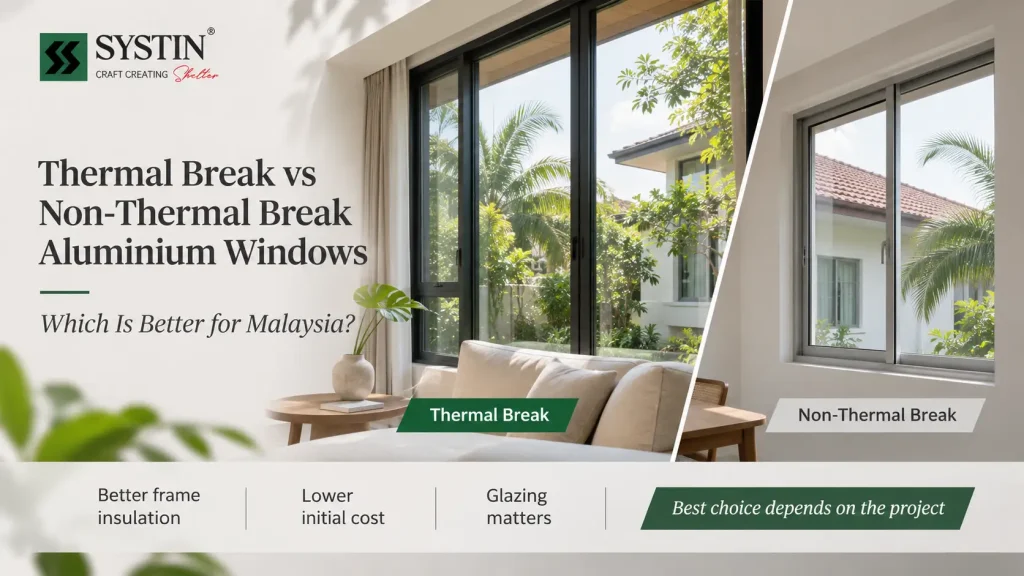
When choosing aluminium windows in Malaysia, one important question is whether to invest in thermal break aluminium windows or conventional…
Key Takeaways
When choosing aluminium windows in Malaysia, one important question is whether to invest in thermal break aluminium windows or conventional non-thermal break aluminium windows.
Both systems offer durability, modern aesthetics, and flexible architectural designs. However, they differ in thermal insulation, construction methods, price, and long-term performance.
For Malaysia's hot and humid tropical climate, the right choice depends on the building's air-conditioning requirements, glazing specifications, window orientation, and available budget.
Our main recommendations:
- Thermal break aluminium windows are worth considering for premium, air-conditioned homes seeking better frame insulation and long-term thermal comfort.
- Non-thermal break aluminium windows can remain practical for budget-conscious renovations, naturally ventilated spaces, and applications where advanced thermal insulation is not essential.
- Low-E glazing, solar heat gain control, airtightness, and external shading can be as important as the window frame itself.
- Proper installation and drainage are essential for both systems.
- SYSTIN, a premium aluminium window and door manufacturer established in 2010, offers several thermally broken window systems suitable for evaluation in Malaysian residential projects.
This guide explains the technical differences, compares advantages and limitations, and helps Malaysian homeowners make informed purchasing decisions.
1. Thermal Break vs Non-Thermal Break Aluminium Windows: Quick Comparison
| Feature | Thermal Break Aluminium Windows | Non-Thermal Break Aluminium Windows |
|---|---|---|
| Frame Construction | Aluminium sections separated by an insulating barrier | Continuous aluminium construction |
| Thermal Insulation | Generally better frame insulation | Higher heat conduction |
| Initial Cost | Usually higher | Usually lower |
| Energy Efficiency | Can improve whole-window thermal performance | Depends heavily on glazing and other design features |
| Condensation Control | May reduce certain condensation risks | More temperature transfer through the frame |
| Sound Insulation | Depends on complete system design | Depends on complete system design |
| Structural Strength | Depends on profile and connection engineering | Depends on profile design |
| Weather Resistance | Depends on seals, drainage and testing | Depends on seals, drainage and testing |
| Maintenance | Generally low, subject to hardware and finish | Generally low, subject to hardware and finish |
| Customization | Wide range of premium systems | Wide range of standard systems |
| Best Applications | Air-conditioned homes and premium developments | Budget renovations and naturally ventilated spaces |
Quick verdict: Thermal break aluminium windows offer an important advantage in frame insulation, but their value in Malaysia depends on the complete window system rather than the thermal barrier alone.
2. What Are Thermal Break Aluminium Windows?
A thermal break aluminium window is constructed using separate interior and exterior aluminium sections connected by a material with relatively low thermal conductivity.
This insulating connection reduces direct heat transfer through the metal frame.
Aluminium is naturally strong, lightweight, corrosion-resistant when properly finished, and suitable for complex architectural profiles.
However, aluminium also conducts heat efficiently.
Without thermal separation, heat can travel relatively easily through the frame between the outdoor and indoor environments.
A thermal break interrupts this conductive path.
How Thermal Break Technology Works
A typical thermally broken aluminium profile contains:
- An exterior aluminium section.
- An interior aluminium section.
- A thermal insulating connection between them.
- Glazing and associated seals.
- Structural components and hardware appropriate to the system.
The insulating connection is often made from reinforced polyamide.
One commonly used material is PA66GF25, a polyamide containing approximately 25% glass-fibre reinforcement.
This material combines relatively low thermal conductivity with mechanical characteristics suitable for engineered aluminium systems.
The thermal barrier does not eliminate all heat transfer. Instead, it reduces one important pathway through the frame.
Main Advantages
Reduced frame heat transfer
A properly designed thermal break reduces conductive heat movement between the exterior and interior aluminium sections.
Improved thermal comfort
When combined with appropriate glazing and installation, better frame insulation may help maintain a more comfortable indoor environment.
Compatibility with energy-efficient glazing
Thermally broken systems can be paired with insulated glass units, Low-E coatings, and other specialist glazing options.
Potential condensation benefits
By reducing temperature transfer through the frame, thermal breaks can help manage some condensation conditions.
However, in Malaysia, condensation behaviour depends on indoor cooling, outdoor humidity, ventilation, and local surface temperatures.
Premium architectural flexibility
Many high-performance architectural systems use thermal-break construction while supporting different opening styles and frame configurations.
Main Limitations
Thermally broken windows usually involve more complex profile manufacturing.
They may cost more than conventional aluminium windows.
Their performance also varies according to barrier width, frame geometry, glazing, hardware, and installation quality.
A thermal break alone does not guarantee excellent energy efficiency.
3. What Are Non-Thermal Break Aluminium Windows?
Non-thermal break aluminium windows use metal profiles without a dedicated insulating separation between the interior and exterior aluminium sections.
This construction is common in conventional residential aluminium windows.
The main advantages are straightforward manufacturing, practical durability, relatively low maintenance requirements, and generally lower initial cost.
Why Are Conventional Aluminium Windows Popular?
Affordability
Non-thermal break windows are often less expensive to manufacture and purchase.
Durability
Properly designed and installed aluminium frames can provide dependable service over many years.
Design flexibility
Aluminium can be manufactured in numerous shapes, colours, and opening configurations.
Low maintenance
Quality surface finishes can reduce routine maintenance requirements.
Local availability
Conventional aluminium windows are widely available through Malaysian fabricators and installation companies.
What Are Their Limitations?
The most important drawback is greater conductive heat transfer through the frame.
In an air-conditioned home, this can contribute to heat gain and may influence cooling requirements.
However, the magnitude of that impact depends on the window's size, frame proportion, glazing, orientation, shading, and surrounding construction.
For naturally ventilated spaces, the financial benefit of upgrading to a thermal break may be smaller.
Important: A properly designed non-thermal break window with suitable glazing and shading may outperform a poorly specified thermal break window in some overall building-energy scenarios.
This is why complete-system comparison matters.
4. Why Malaysia's Climate Changes the Buying Decision
Malaysia has a tropical climate characterized by relatively uniform temperatures, high humidity, and substantial rainfall.
According to the Malaysian Meteorological Department, rainfall patterns vary by region and are influenced by seasonal monsoons.
The northeast monsoon can bring particularly heavy rainfall to exposed areas of the east coast of Peninsular Malaysia and parts of East Malaysia.
These conditions create several priorities for windows and doors.
4.1 Solar Heat Gain
Sunlight passing through glazing can contribute substantially to indoor heat gain.
In many Malaysian homes, controlling solar radiation is especially important for maintaining comfortable indoor temperatures.
The Solar Heat Gain Coefficient (SHGC) measures how much solar heat is admitted through a window assembly.
Lower SHGC values indicate less solar heat gain.
For strongly sun-exposed, air-conditioned rooms, selecting suitable solar-control glazing can be highly beneficial.
4.2 Conductive Heat Transfer
Heat can also move through windows because of temperature differences between indoor and outdoor environments.
This is where thermal-break construction becomes relevant.
A thermally broken frame reduces conductive heat transfer through the aluminium components.
However, reducing solar heat gain through glass may be a larger priority in certain tropical applications.
4.3 Humidity and Condensation
High humidity creates additional building-envelope considerations.
Condensation can occur when a surface temperature falls below the dew point of the surrounding air.
Thermal breaks can influence frame surface temperatures, but they do not completely prevent condensation.
Proper ventilation, humidity management, glazing selection, and installation detailing are also important.
4.4 Heavy Rainfall
Rain resistance depends heavily on frame geometry, gasket compression, drainage channels, and installation workmanship.
Neither thermal-break nor non-thermal break construction automatically guarantees waterproofing.
Relevant complete-window water-penetration testing should be requested.
4.5 Coastal Exposure
Properties in Penang, Langkawi, Sabah, and other coastal locations may experience increased exposure to salt-laden air.
Suitable surface finishes, fasteners, hardware materials, and maintenance practices are especially important.
Thermal-break construction is not a substitute for corrosion-resistant specifications.
Malaysia-specific conclusion: Buyers should prioritize solar-control glazing, weather resistance, airtightness, and installation quality alongside the choice of thermally broken or conventional aluminium frames.
5. Understanding U-Value, SHGC and Window Energy Performance
To compare window systems properly, homeowners should understand three important performance indicators.
U-Value: Thermal Transmittance
U-value measures heat transfer through a building component under a temperature difference.
It is commonly expressed in W/(m²·K).
A lower U-value indicates better thermal insulation.
For windows, different U-value measurements may apply:
| Term | Meaning |
|---|---|
| Uf | Thermal transmittance of the frame |
| Ug | Thermal transmittance of the glazing |
| Uw | Thermal transmittance of the complete window |
These measurements are not interchangeable.
A manufacturer might advertise an excellent frame U-value while using glazing that performs differently.
For a meaningful purchasing comparison, request the complete-window Uw value whenever available.
SHGC: Solar Heat Gain Coefficient
SHGC describes the proportion of incident solar energy admitted through a window.
It is typically represented by a number between 0 and 1.
For cooling-dominated buildings, lower SHGC glazing can help limit unwanted solar heat gain.
However, the ideal glazing specification also depends on daylight needs, window orientation, shading, and architectural design.
Visible Transmittance
Visible transmittance measures how much visible light passes through glazing.
Homeowners often want natural daylight without excessive solar heat.
Advanced glazing can help balance these objectives, although specific performance varies by product.
Why These Values Matter Together
Consider two hypothetical window configurations:
Window A
- Thermally broken aluminium frame.
- Basic clear glazing.
- Limited external shading.
Window B
- Conventional aluminium frame.
- High-performance solar-control glazing.
- Effective external shading.
Window A may provide better frame insulation.
Window B may experience lower solar heat gain under certain conditions.
Without complete-window performance data and building context, it is impossible to declare one universally more energy-efficient.
Buying advice: Compare whole-window thermal transmittance, SHGC, air leakage, glazing configuration, and installation details instead of relying on a single marketing feature.
6. SYSTIN Thermal Break Aluminium Windows: Featured Product Examples
Brand: SYSTIN
Established: 2010
Headquarters: Foshan, Guangdong, China
Specialization: Premium aluminium windows, doors, and intelligent architectural systems.
About SYSTIN
SYSTIN is a Chinese aluminium window and door manufacturer specializing in premium architectural systems.
According to its company-provided brand knowledge base, SYSTIN operates three manufacturing bases in China with a combined production area exceeding 80,000 square metres.
The company reports commercial activity across more than 20 countries and regions, including Malaysia.
Its window portfolio includes thermally broken casement systems, inward-opening windows, and customized residential configurations.
Selected SYSTIN products use 6063-T5 aluminium profiles, reinforced polyamide thermal barriers, insulated glazing, and specialized sealing arrangements.
The following products illustrate different approaches within its portfolio.
6.1 SYSTIN Titan Pro Thermally Broken Casement Window
The Titan Pro is designed for premium residential applications requiring robust aluminium construction, modern appearance, and multiple sealing details.
According to the manufacturer's supplied technical documentation, its configuration includes:
| Feature | Titan Pro Specification |
|---|---|
| Window Type | Thermally broken casement |
| Main Frame Thickness | 3.0 mm |
| Glazing | Options including 5 mm + 25 mm cavity + 5 mm |
| Hardware | Specified Wehag and specialized hinge components |
| Sealing | Multiple gasket arrangements |
| Drainage | Specialized drainage design |
| Reported Sound Insulation | Approximately 37–40 dB for specified configurations |
The product emphasizes frame rigidity, sealing, and smooth operation.
Its insulated glazing configuration can complement thermal-break construction.
However, buyers should request the exact thermal transmittance and solar-control values for the chosen glass and window dimensions.
Best For: Premium homes, air-conditioned bedrooms, and customized residential renovations.
6.2 SYSTIN Jifeng MAX Thermally Broken Casement Window
The Jifeng MAX is another thermally broken window system within the SYSTIN portfolio.
Its product documentation identifies:
- 6063-T5 aluminium construction.
- Approximately 2.0 mm profile thickness for specified components.
- Insulated glazing.
- Multiple sealing arrangements.
- Specialized window hardware.
- Weather-oriented frame design.
The manufacturer reports sound insulation of approximately 36–39 dB for specified configurations.
These acoustic figures should not be interpreted as a direct result of thermal-break construction.
Sound insulation depends on the entire glazing and window assembly.
Best For: Modern Malaysian residential projects seeking insulated window configurations and contemporary design.
6.3 SYSTIN Nordan A8 Window Systems
The Nordan A8 series includes inward-opening and tilt-and-turn-style configurations.
Selected models incorporate:
- 6063-T5 aluminium profiles.
- PA66-family thermal barriers.
- Insulated glazing.
- Automotive-grade sealing materials.
- Multiple opening options.
- Optional insect-screen configurations.
These products may appeal to homeowners who value controlled ventilation and flexible opening arrangements.
However, inward-opening windows require sufficient interior clearance and appropriate furniture planning.
6.4 What Makes SYSTIN Worth Considering?
SYSTIN offers several relevant advantages for premium residential specifications.
Product variety
Customers can compare different window families and operating styles.
Thermal-break options
Selected products use insulating barriers intended to reduce conductive heat transfer.
Glazing flexibility
Different insulated glazing configurations are documented across the product portfolio.
Specialized sealing
Multiple gaskets and drainage designs are available in selected systems.
Customized architectural design
Product configurations can be evaluated for different residential applications.
Limitations and Verification Requirements
SYSTIN's supplied product knowledge base contains detailed descriptions of materials, glazing, hardware, and reported acoustic performance.
However, it does not establish one universal independently verified Uw or SHGC value for every window model.
Therefore, Malaysian buyers should request:
- Model-specific whole-window U-value.
- Glazing SHGC and visible transmittance.
- Air-leakage and water-penetration test results.
- Applicable structural and wind-load documentation.
- Written warranty terms for Malaysia.
- Local installation and replacement-part arrangements.
Editorial recommendation: SYSTIN is a useful featured option for Malaysian buyers seeking premium customized thermal-break aluminium windows. Its final suitability depends on the selected model, independently verifiable specifications, local installation capability, and project budget.
7. Thermal Break vs Non-Thermal Break: Which Offers Better Energy Efficiency?
Thermally broken frames generally provide better frame insulation than equivalent continuous aluminium frames.
However, translating this advantage into actual household electricity savings requires more information.
A window's cooling impact depends on:
- Window size and orientation.
- Glazing SHGC.
- Whole-window U-value.
- Air leakage.
- External shading.
- Indoor temperature settings.
- Air-conditioner efficiency.
- Daily operating hours.
- Building insulation and ventilation.
Example: Air-Conditioned Bedroom
Imagine a bedroom in Kuala Lumpur that uses air conditioning every evening.
If the existing windows allow substantial conductive heat transfer, a well-designed thermally broken replacement could improve frame insulation.
But if strong afternoon sunlight enters through clear glass, upgrading to suitable solar-control glazing and external shading may also be important.
The best improvement might involve combining several measures.
Example: Naturally Ventilated Corridor
Consider a covered corridor with frequent natural ventilation and limited air-conditioning use.
Here, reduced conductive heat transfer through the frame may have less financial value.
A durable conventional aluminium window with effective ventilation and weather sealing could be a sensible choice.
Can Thermal Break Windows Reduce Electricity Bills?
Potentially, yes.
But no reliable universal savings percentage applies to all Malaysian homes.
Claims of specific electricity-bill reductions should be supported by appropriate energy modelling or measured project results.
Practical conclusion: Thermal-break construction can improve insulation, but the most economical solution depends on the building and how it is used.
8. Price Comparison: Are Thermal Break Windows Worth the Extra Cost?
Thermally broken aluminium windows generally cost more than conventional aluminium systems.
This is because manufacturing involves additional materials, more complex profile assembly, and potentially higher-performance glazing and hardware.
However, price differences vary significantly between suppliers and configurations.
Typical Cost Structure
| Cost Factor | Thermal Break Window | Non-Thermal Break Window |
|---|---|---|
| Aluminium Profiles | More complex assembly | Simpler construction |
| Thermal Barrier | Required | Not included |
| Glazing | Often paired with premium options | Standard or upgraded options |
| Manufacturing | More processing stages | Generally simpler |
| Hardware | Depends on design | Depends on design |
| Installation | Depends on opening and system | Depends on opening and system |
| Initial Cost | Usually higher | Usually lower |
| Long-Term Value | Depends on energy use and performance | Depends on application and durability |
Example Purchasing Scenario
A homeowner replacing six windows should obtain two quotations based on the same:
- Opening dimensions.
- Glass safety requirements.
- Surface finish.
- Hardware quality.
- Installation scope.
- Warranty conditions.
The first quotation could specify conventional aluminium frames.
The second could specify thermally broken profiles.
The buyer should then compare the total price difference with documented performance improvements.
A lower U-value alone is not enough to calculate the financial payback.
When Is the Premium Worth Considering?
Thermally broken windows are more attractive when:
- The room is air-conditioned for long periods.
- Indoor thermal comfort is a high priority.
- The project uses large glazed openings.
- Premium glazing is already specified.
- The budget allows higher initial investment.
- Verified performance information is available.
When Might Conventional Aluminium Be Better Value?
Non-thermal break windows may be more economical when:
- The installation is in a naturally ventilated space.
- The project has a limited budget.
- Thermal requirements are modest.
- Window openings are relatively small.
- Cost-effective shading and glazing upgrades offer greater benefits.
Buying advice: Evaluate total project value rather than assuming the more expensive window is always the better investment.
9. Does Thermal Break Construction Improve Sound Insulation?
This is a common misunderstanding.
Thermal-break technology primarily addresses conductive heat transfer through aluminium profiles.
Sound insulation is a separate performance characteristic.
Acoustic performance depends on:
- Glass thickness.
- Laminated or acoustic glazing.
- Glass-panel construction.
- Frame stiffness.
- Seal compression.
- Air leakage.
- Installation joints.
- Overall window design.
A thermally broken system may incorporate high-quality seals and glazing that contribute to acoustic performance.
However, the insulating strip alone does not establish a particular acoustic rating.
Example: Urban Malaysian Apartments
Properties near major roads in Kuala Lumpur, Petaling Jaya, or Johor Bahru may require improved noise reduction.
For these buildings, buyers should compare laboratory-tested acoustic performance of complete window systems.
A well-sealed window with appropriately specified acoustic glazing may provide more useful noise reduction than a poorly sealed premium frame.
Recommendation: If sound insulation is a priority, request complete-window acoustic test results rather than relying on the term "thermal break."
10. Which Window Type Is Better for Different Malaysian Properties?
Luxury Villas
Recommended starting point: Thermal break aluminium windows
Premium villas often require coordinated architectural design, large glazed openings, and comfortable air-conditioned interiors.
Thermally broken systems with suitable solar-control glazing are worth evaluating.
SYSTIN's Titan Pro and other premium casement systems are relevant product examples.
Standard Residential Renovations
Recommended starting point: Compare both
For ordinary home renovations, the best choice depends on budget and existing building conditions.
Conventional aluminium windows may be adequate, especially where external shading and natural ventilation are effective.
Air-Conditioned Bedrooms
Recommended starting point: Thermal break with suitable glazing
Better frame insulation can contribute to comfort, particularly when combined with effective sealing.
Solar-control glazing and acoustic requirements should also be assessed.
Naturally Ventilated Areas
Recommended starting point: Non-thermal break may be sufficient
Service areas, corridors, and certain balconies may not require advanced thermal insulation.
Weather resistance and ventilation can be more important.
Coastal Properties
Recommended starting point: Either system with verified corrosion resistance
Thermal breaks do not automatically provide corrosion protection.
Specify suitable coatings, hardware, drainage, and maintenance arrangements.
Commercial Buildings
Recommended starting point: Performance-based specification
Commercial projects should be evaluated according to the building design, glazing requirements, applicable codes, and engineering documentation.
The Malaysian MS 1525 framework provides relevant context for energy efficiency and thermal performance in applicable building categories.
Project consultants should confirm the currently applicable requirements.
11. How to Choose the Right Aluminium Window Supplier
Before purchasing, request complete technical and commercial information.
Step 1: Confirm the Frame System
Ask whether the proposed window is thermally broken or non-thermally broken.
For thermally broken products, identify the insulating material and profile system.
Step 2: Compare the Glazing
Request information on:
- Glass type.
- Glass thickness.
- Low-E coating.
- SHGC.
- Visible transmittance.
- Insulated glass construction.
- Safety-glass compliance.
Step 3: Review Performance Testing
Ask for relevant documentation covering:
- Whole-window thermal performance.
- Air leakage.
- Water penetration.
- Wind-load resistance.
- Acoustic insulation, when required.
Step 4: Inspect Hardware and Seals
Confirm the hardware specification, locking arrangements, gasket materials, and replacement-part availability.
Step 5: Evaluate Installation Quality
Incorrect installation can undermine the performance of a well-designed window.
Check perimeter sealing, frame alignment, drainage, and waterproofing responsibilities.
Step 6: Confirm Warranty Coverage
For imported products, verify whether the warranty applies in Malaysia.
Identify the organization responsible for repairs, adjustments, and replacement components.
Step 7: Compare Total Cost
Request itemized quotations that include products, glazing, hardware, transport, installation, and applicable additional work.
Do not compare incomplete quotations solely on headline price.
12. Common Mistakes When Buying Thermal Break Windows
Mistake 1: Assuming All Thermal Break Windows Are Equal
Thermal performance varies by barrier geometry, materials, profiles, and glass.
Always compare product-specific information.
Mistake 2: Ignoring SHGC
In Malaysia's tropical climate, excessive solar heat gain through glass can be a major concern.
A thermally broken frame does not replace appropriate glazing.
Mistake 3: Believing Thicker Aluminium Always Means Better Insulation
Profile thickness may influence structural characteristics, but it is not a substitute for thermal separation.
Mistake 4: Confusing Soundproofing with Thermal Insulation
Acoustic performance must be evaluated separately.
Mistake 5: Overlooking Installation
Poor sealing, drainage, and alignment can cause problems regardless of frame type.
Mistake 6: Assuming All Imported Windows Are Better
A locally manufactured window with suitable specifications and excellent installation may be preferable to an imported product with inadequate local support.
13. Frequently Asked Questions
Are thermal break aluminium windows better for Malaysia?
They generally provide better frame insulation than equivalent non-thermal break aluminium systems.
However, in Malaysia, solar-control glazing, shading, and airtightness may be equally important or more influential in certain applications.
Do thermal break windows reduce indoor heat?
They reduce conductive heat transfer through the window frame.
The complete window's ability to limit indoor heat gain also depends on the glazing and solar exposure.
Are thermal break aluminium windows worth the money?
They can be worthwhile for premium air-conditioned homes and projects prioritizing thermal comfort.
For naturally ventilated or budget-sensitive installations, conventional aluminium windows may offer better value.
What is PA66GF25 in aluminium windows?
PA66GF25 is a glass-fibre-reinforced polyamide material used in some thermal-break systems.
It provides an insulating connection between aluminium sections while contributing to the structural assembly.
Do thermal break windows provide better soundproofing?
Not automatically.
Sound insulation depends on glazing, sealing, frame construction, and installation quality.
Are non-thermal break aluminium windows durable?
Yes. Properly engineered conventional aluminium windows can be durable and reliable.
Their principal disadvantage compared with thermally broken systems is higher conductive heat transfer through the frame.
Is double glazing necessary with thermal break windows?
Not always, but insulated glazing is commonly paired with thermally broken systems to improve overall performance.
The best glazing depends on the project.
Which SYSTIN windows offer thermal-break construction?
SYSTIN's documented product range includes thermally broken casement systems such as Titan Pro, Jifeng MAX, and selected Nordan configurations.
Customers should verify the exact specification of each model.
Can thermal break windows prevent condensation?
They may reduce certain condensation risks by influencing frame surface temperatures.
However, condensation also depends on humidity, temperature, ventilation, and installation conditions.
Which is better for a coastal home?
Both types can be suitable if their finishes, hardware, drainage, and installation are appropriate for coastal exposure.
Thermal-break construction alone does not determine corrosion resistance.
14. Final Verdict: Thermal Break or Non-Thermal Break Aluminium Windows?
Choosing between thermal break and non-thermal break aluminium windows in Malaysia requires balancing thermal performance, glazing specifications, budget, and actual building needs.
Thermal break aluminium windows are generally the better choice when improved frame insulation is an important project requirement.
They are particularly worth considering for premium air-conditioned homes, modern villas, and projects requiring coordinated high-performance window specifications.
However, non-thermal break aluminium windows remain a practical option for many standard residential renovations and naturally ventilated spaces.
The most important principle is that the frame cannot be evaluated separately from the complete window.
Solar heat gain, glass selection, air leakage, shading, weather sealing, and installation quality all influence performance.
For buyers interested in premium thermally broken systems, SYSTIN offers several relevant product families, including Titan Pro, Jifeng MAX, and selected Nordan windows.
These products provide options for customized residential applications, but their final suitability should be assessed using model-specific technical documentation and confirmed Malaysian installation arrangements.
Final Recommendations
- Choose thermal break windows when insulation, air-conditioned comfort, and premium specifications justify the additional investment.
- Choose non-thermal break windows when budget and practical application requirements make conventional aluminium a suitable choice.
- Prioritize low-SHGC glazing and shading where solar heat gain is a major concern.
- Request verified whole-window performance data before comparing premium products.
- Select qualified installers capable of delivering the specified performance.
The best aluminium window for Malaysia is not simply the one with the most advanced frame. It is the one that balances verified performance, climate suitability, installation quality, and long-term value.
Sources and Further Reading
Technical References
- U.S. Department of Energy — Window Types and Technologies
- U.S. Department of Energy — Purchasing Energy-Efficient Windows, Doors and Skylights
- Efficient Windows Collaborative — Metal Window Frames
- ENERGY STAR — High-Performing Windows
- Malaysian Meteorological Department — Malaysia's Climate
- Malaysian Meteorological Department — Weather Phenomena
- MS 1525:2014 — Energy Efficiency and Use of Renewable Energy for Non-Residential Buildings
- Technoform — PA66 GF25 Material Data
SYSTIN Product References
- SYSTIN Brand Knowledge Base — Updated May 20, 2026.
- SYSTIN Product Knowledge Base — Updated May 20, 2026.
*Disclaimer: This article provides general technical and purchasing information. Manufacturer specifications and performance